
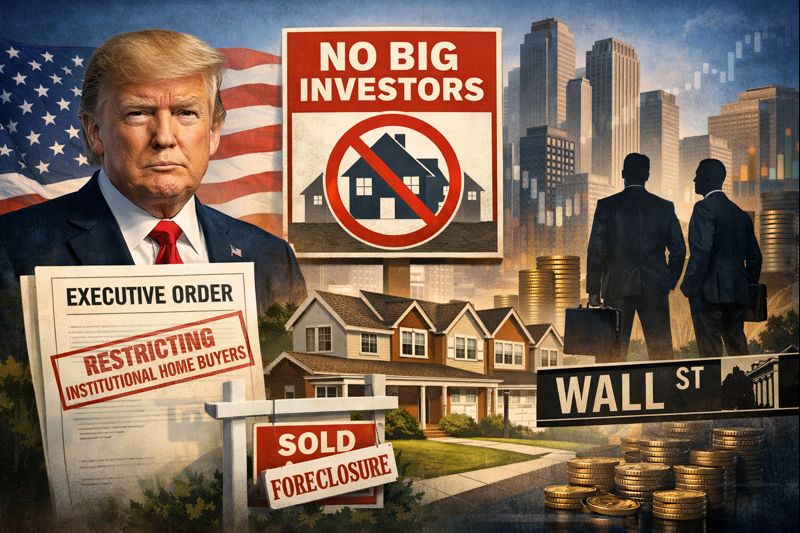
President Trump’s executive order targeting institutional investors in single-family housing is making headlines, but the actual impact, at least in the short term, may be more symbolic than structural. While the order sets a firm tone against large firms competing with families for homes, the devil is in the definitions and implementation. It gives the Treasury Department 30 days to define what qualifies as a “large institutional investor,” and until those guidelines are clear, there’s a lot of room for interpretation. For now, the order primarily restricts federal agencies from selling or facilitating the sale of government-held single-family homes to large investors that could be purchased by owner-occupants instead. That’s a relatively narrow slice of the market.
Big players, hedge funds and REITs with thousands of homes under management, are the clear targets here, especially those scooping up distressed or foreclosed homes in bulk from government sources. But most of the private acquisitions of single-family homes by large investors aren’t coming directly from the government anymore. Much of that happened in the post-2008 era. These days, institutional investors are buying on the open market like everyone else, often competing with families, but also paying retail. The executive order doesn’t restrict that. It also includes exceptions for build-to-rent communities, which have been a major area of growth for institutional capital and are excluded as long as they’re developed specifically for rental purposes. So Wall Street’s larger rental operations aren’t going anywhere for now.
What may change, though, is the trajectory for growth. If the definitions end up being strict, and if the order gains legislative backing (a big “if” in an election year), it could make it harder for large funds to scale further into single-family rentals. That might create some room for smaller-scale investors, individuals or partnerships that own a handful of properties, to compete more effectively in certain markets. Those folks could benefit if government-owned home sales shift in favor of owner-occupants or smaller investors. And if federal disclosures or anti-competitive investigations expand, we could see some transparency in an area that’s long been murky.
At the end of the day, the order’s tone is more populist than punitive. It frames Wall Street as the villain and homebuyers as the victim, which may resonate politically, but the practical effects will depend on how the details get filled in. For now, institutional investors aren’t going to be rushing for the exits, but they’ll definitely be watching closely.