
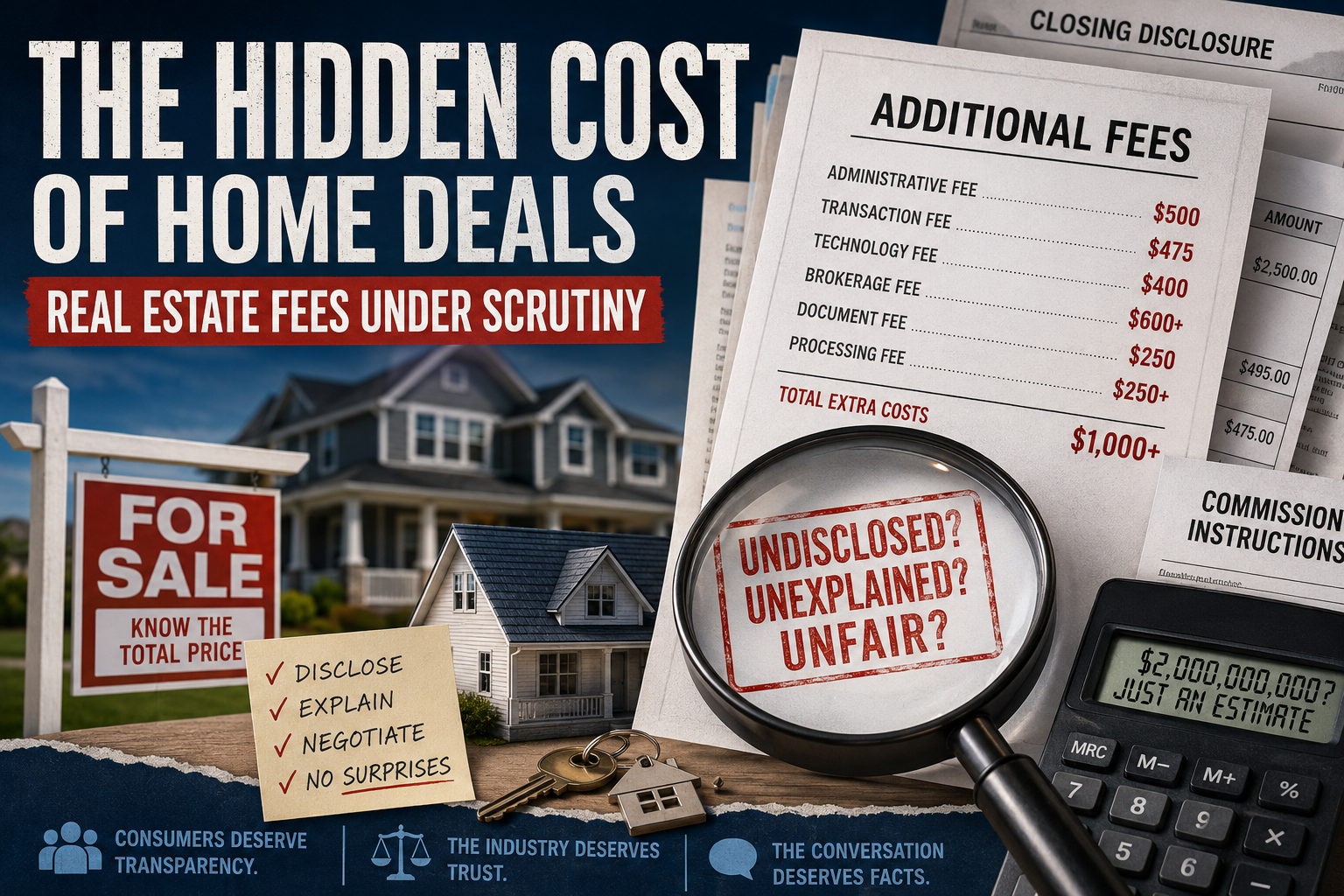
A new report from the Consumer Policy Center , “Junk” Fees Charged to Both Home Sellers and Buyers: An Overview, is taking aim at the administrative, transaction, technology and brokerage fees charged by many real estate companies in addition to their regular commissions. The report, authored by Consumer Policy Center senior fellow Stephen Brobeck and fellow Wendy Gilch, says these fees generally range from $400 to $600, sometimes exceed $1,000 and are charged to most home buyers and sellers. The accompanying press release goes even further, reporting fees as high as $2,500 and estimating that consumers pay nearly $2 billion a year. Those claims are getting attention, as they should, but after reviewing the report, I think its strongest conclusion is considerably narrower than its headline suggests. Undisclosed or poorly explained fees deserve scrutiny, but this report does not establish how frequently they are actually being charged nationwide.
To its credit, the report openly acknowledges its limitations. The authors say they could not find a publicly available source of national data on brokerage administrative fees and describe their work as more like an investigative report than the scholarly research they have published in the past. Much of the evidence comes from conversations with industry members and comments posted by agents, brokers and mortgage professionals on Reddit, Facebook, TikTok, Quora and other social media platforms. Hundreds of comments can certainly establish that the practice exists, that it is widespread in some markets and that many agents strongly dislike it. What those comments cannot establish is the percentage of all buyers and sellers nationwide who are paying the fees. People posting complaints online are also not a representative sample of the millions of consumers and agents involved in real estate transactions each year.
The nearly $2 billion estimate is the clearest example of the difference between an estimate and a finding. The authors arrive at that number by assuming that half of all buyers and sellers pay an average fee of $500. That may turn out to be accurate, too high or too low, but it is still an assumption rather than a total derived from closing statements, brokerage agreements or a representative consumer survey. The report appropriately calls it a rough estimate, but the press release presents the broader conclusions with more certainty, including the claim that most buyers and sellers are routinely charged these fees. Based on the evidence presented, I think the report can reasonably say these fees are common and deserve further investigation. I do not think it proves they appear in most transactions.
That does not mean the real estate industry should dismiss the report. Calling every separate charge a “junk fee” decides the issue before examining how the brokerage actually prices its services. Real estate compensation can legitimately be structured as a percentage, a flat fee, an hourly charge, a retainer or some combination of those. A clearly disclosed $500 transaction fee negotiated as part of the original compensation agreement is not hidden merely because it is separate from the percentage commission. The consumer can evaluate the total cost, ask what the fee covers, negotiate it or select another brokerage. The problem arises when a brokerage advertises or discusses one compensation amount and then adds another fee that was not clearly explained or agreed to.
There is also an important distinction between a fee charged by a brokerage to its agent and a fee owed by the consumer. A broker may charge its agents transaction fees, technology fees, franchise fees, risk management fees or any number of other internal expenses. That is part of the financial arrangement between the brokerage and the agent. It does not automatically make the buyer or seller responsible for reimbursing the agent. If the agent wants the client to pay it, that charge should be part of the compensation discussion from the beginning. Saying that the brokerage requires the fee may explain where it came from, but it does not explain why the consumer should pay it on top of the commission already being charged.
Disclosure is where this becomes more than a debate over pricing. Under the practice changes resulting from the National Association of REALTORS® settlement, an MLS participant working with a buyer generally must enter into a written agreement before touring a property. That agreement must clearly disclose the amount or rate of compensation the brokerage will receive, or explain how it will be determined in a way that is objectively ascertainable. The parties can mutually agree to amend their agreement later, so the mere fact that compensation changes during the relationship does not automatically prove misconduct. However, a fee that simply appears in commission instructions or on a closing statement without a genuine agreement is very different. The report may be too broad when it states that late disclosure necessarily violates the settlement and state law, since that depends on the agreement, the parties, the jurisdiction and the surrounding facts, but the proper business practice should not be difficult to understand. The client should know the total compensation before becoming committed to the transaction.
A proposed class action lawsuit against Compass Florida has brought the issue into sharper focus. The buyers allege that they were charged a $475 transaction fee at closing after being told their buyer agent would be compensated through the commission paid by the seller. The complaint also challenges how the charge was placed in the additional terms section of a Florida Realtors and Florida Bar approved purchase contract. Compass has responded that transaction fees have been standard practice for years in major markets and are used by many other brokerage brands. The case has not been decided, so the allegations should not be reported as established facts. Still, the transaction illustrates why this is not solely a Compass issue. The closing statement reportedly showed that the seller in the same transaction paid a separate $495 transaction fee to the listing brokerage, SERHANT, in addition to the commission.
The most persuasive part of the Consumer Policy Center report may be its appendix, which contains dozens of comments from agents who say they refuse to charge the fee, pay it out of their own commission or have left brokerages that required it. Some of the language is colorful, but the underlying message is important. When experienced agents cannot explain a fee to their clients without feeling embarrassed or relying on a company supplied script they do not believe, the brokerage should pay attention. Technology, regulatory compliance, document retention, insurance, supervision and transaction processing all cost money, but they are also normal expenses of operating a real estate brokerage. A company is entitled to recover those costs through its pricing, but it should be honest about the total price rather than treating part of its overhead as a surprise add-on.
The report is also right that a fixed fee has a greater impact on consumers purchasing lower priced homes. A $500 fee represents one third of one percent of a $150,000 sale, but less than seven hundredths of one percent of a $750,000 sale. For a first time buyer already struggling with a down payment, inspections, loan costs, insurance and other closing expenses, another $500 can matter. That does not automatically make the fee deceptive, but it makes early disclosure and a clear explanation of value even more important. The industry should not respond by attacking consumer advocates for raising the issue. At the same time, consumer advocates should not turn anonymous comments and selected closing statements into national statistics without a more reliable dataset.
My take is fairly simple. Brokerages and agents have the right to establish and negotiate their compensation, and consumers have the right to know the total price before committing to the relationship or the transaction. If an administrative fee is part of the compensation, put it plainly in the agreement, discuss it in dollars, explain what it covers and allow the client to negotiate it. If the fee cannot survive that conversation, it probably should not be charged. The Consumer Policy Center report overstates what its evidence proves about the prevalence and total cost of these fees, but it identifies a legitimate, self-inflicted problem. Brokerages would be wise to address it before more consumers, courts and regulators address it for them.