
The headlines around the NAR settlement made it sound like everything was about to change overnight. Lower commissions, more transparency, a more competitive market. A year later, the reality looks a lot different.
A new report from the Consumer Federation of America and National Urban League, based on a nationwide survey of 223 housing counselors, shows that while the rules changed, the market behavior largely hasn’t. If anything, it’s a good reminder that real estate doesn’t shift on headlines alone… it shifts slowly, and often unevenly.
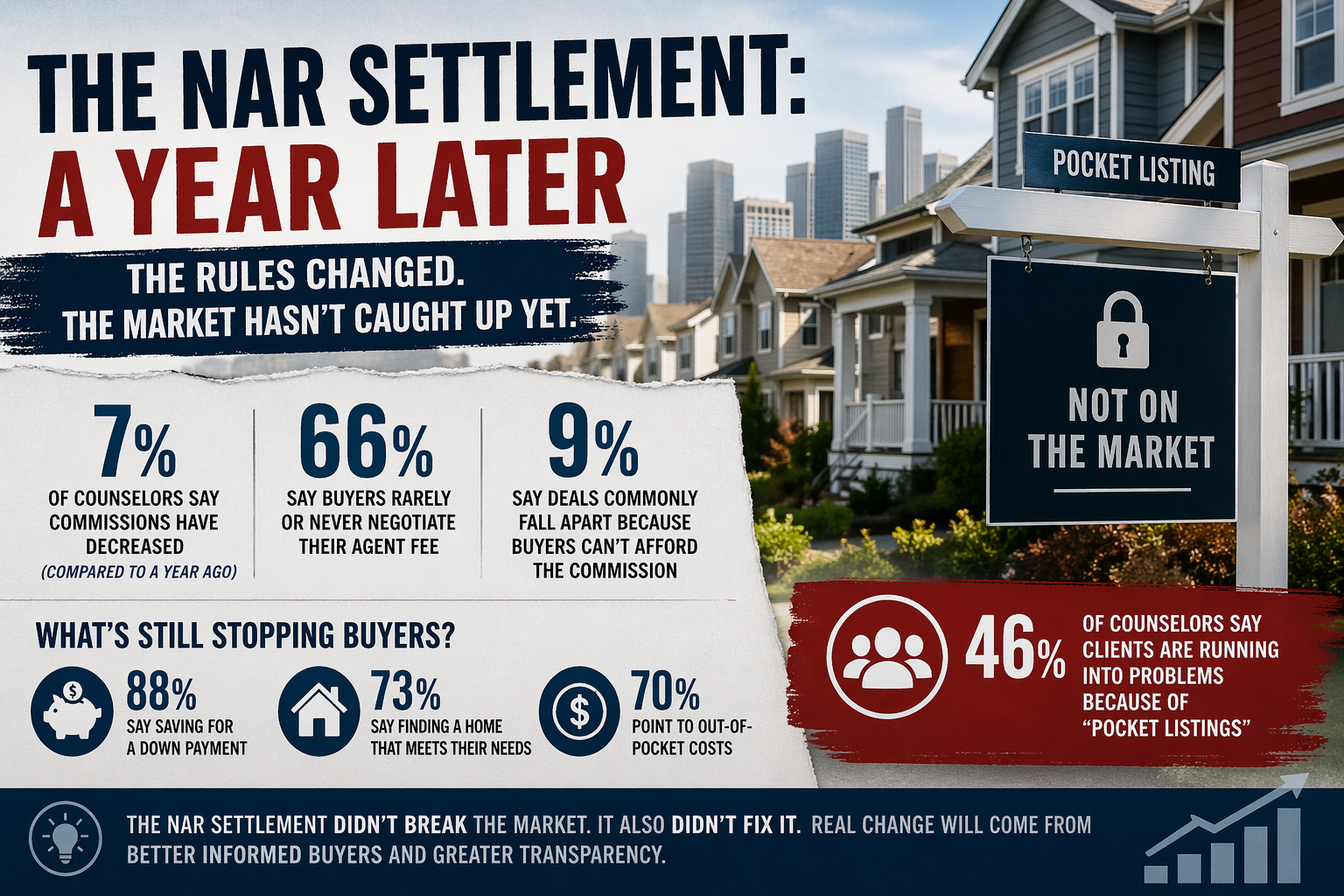
Start with commissions. Only 7 percent of counselors reported that commissions have actually decreased compared to a year ago. Meanwhile, 66 percent said buyers rarely or never negotiate their agent’s fee. That tells you everything you need to know. You can change the rules, but if consumers don’t change their behavior, pricing doesn’t move much.
There was also concern that requiring buyers to potentially pay their own agent would knock first-time buyers out of the market. That hasn’t really happened. Only about 9 percent of counselors said deals commonly fall apart because buyers can’t afford the commission at closing. That’s not nothing, but it’s far from the worst-case scenario many predicted.
What is still stopping buyers? The same things we’ve been talking about for years.
- 88 percent say saving for a down payment is the biggest hurdle
- 73 percent say finding a home that meets their needs
- 70 percent point to out-of-pocket costs
In other words, affordability and inventory remain the real story, not commissions.
But there is one emerging issue that deserves more attention, and frankly, more concern. “Pocket listings.”
These are homes that never hit the open market, instead being shared privately within broker networks. According to the report, 46 percent of housing counselors say their clients are running into problems because of them. In some markets, private listings are growing fast, with certain areas seeing over 20 percent of listings handled this way.
That’s where this gets tricky. Less exposure means less competition, less transparency, and fewer opportunities for buyers, especially first-time buyers. There are also legitimate concerns about fair housing implications if access to listings becomes more selective.
So where does that leave us?
The NAR settlement didn’t break the market. It also didn’t fix it. What it did do is expose how much of real estate pricing and behavior is driven by habit, culture, and consumer awareness rather than just policy.
If anything changes from here, it’s likely to come from better informed buyers who understand they can negotiate, and from increased scrutiny around practices like private listings.
If you want to dig into the full report and data, you can access it here.
The bottom line is simple. The rules changed. The market hasn’t caught up yet.