
Zillow Lawsuit Explodes: RICO Allegations, New Plaintiffs, and a Much Bigger Problem Than Anyone Thought

Zillow Lawsuit Expands With Major New Allegations Including RESPA violations and violation of RICO law. Here’s What Buyers and Agents Should Know

Nine days ago I covered the first class action accusing Zillow of steering buyers toward Zillow Home Loans in exchange for giving certain agents more and better leadsZillow Hit with Class Action Over Alleged Kickbacks to Agents…Is Your Agent Steering You?). That was serious enough.

Now the lawsuit has been amended, and the claims are much bigger. More plaintiffs were added. More real estate companies were named. And the accusations now include RICO violations, which is the same federal law used against large, organized schemes.

Read More

New Rule Would Shift Fair Lending Focus from Outcomes to Intent

CFPB wants to officially clarify that “ECOA does not provide that the ‘effects test’ applies for determining whether there is discrimination” – meaning disparate impact claims would no longer be recognized under the rule.

The Consumer Financial Protection Bureau (CFPB) has proposed a rule that would formally end the use of the “effects test” under the Equal Credit Opportunity Act (ECOA), effectively saying that ECOA does not authorize disparate impact claims. The proposed rule would remove language in Regulation B that has, for decades, opened the door for lenders to be held liable for policies that disproportionately affect protected groups—even if those policies are neutral on their face and not intended to discriminate. The CFPB is taking comments until December 15, 2025, and cited recent executive orders calling for an end to “illegal preferences and discrimination” and eliminating disparate-impact liability in federal enforcement.I think this change is long overdue. The disparate impact standard makes it nearly impossible to create a truly “safe” rule in lending. It puts lenders and financial institutions in a position where everything is subject to interpretation and the outcome matters more than the intent. That’s not just unfair, it’s unsustainable. A lender can have zero intent to discriminate and follow well-established, sound underwriting practices, yet still face legal trouble if their policy affects one group more than another. To me, intent isn’t hard to prove. We prove intent every day in criminal courts across the country. Some rules will inevitably impact certain groups more than others, but if the rule is based on legitimate, non-discriminatory criteria, that should be the...

Read More

Zillow Hit with Class Action Over Alleged Kickbacks to Agents…Is Your Agent Steering You?

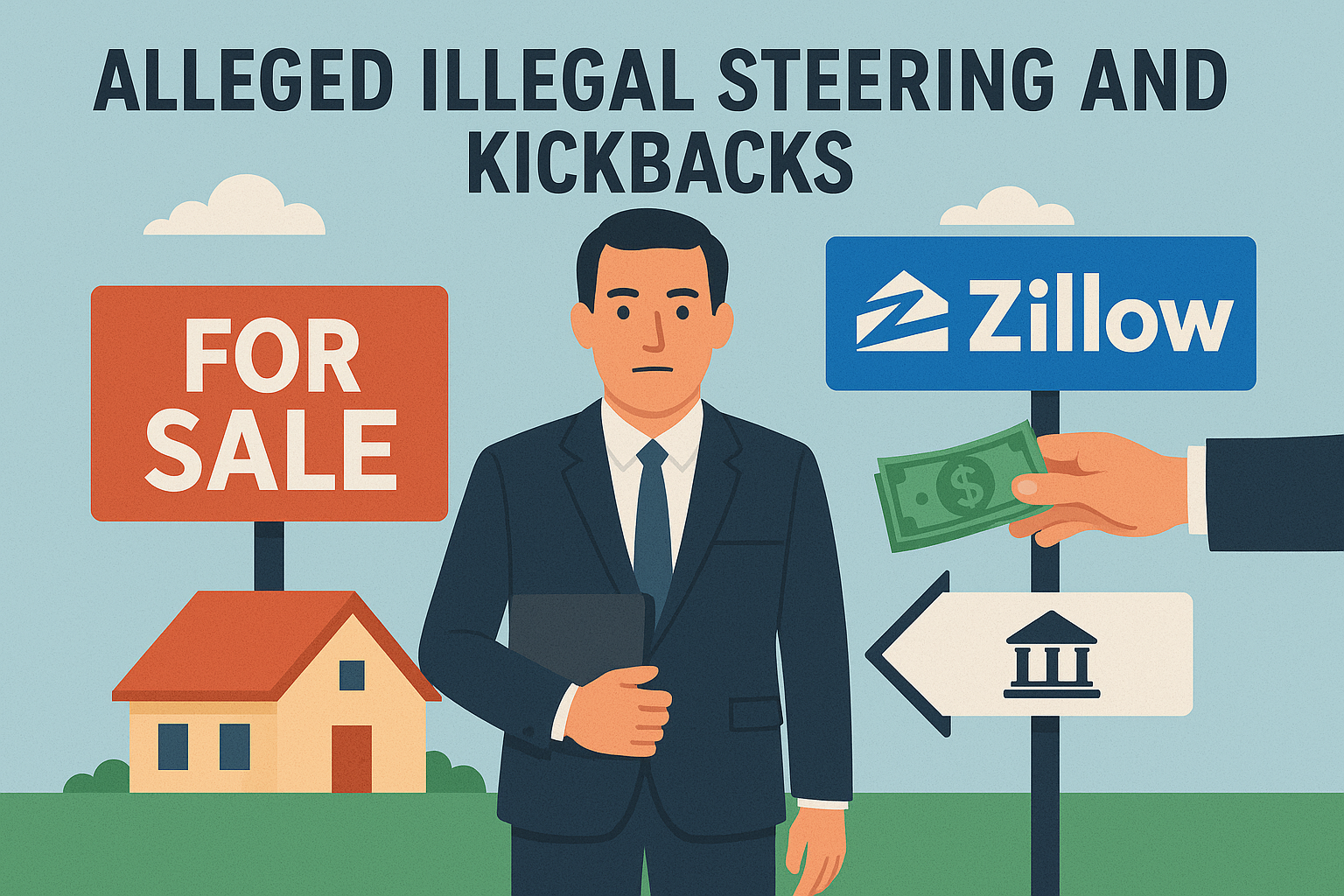
Allegations of Illegal Steering and Kickbacks against Zillow- Class Action Lawsuit- RESPA Violation

A newly filed federal class action lawsuit alleges that Zillow has been quietly pressuring real estate agents to steer buyers toward Zillow Home Loans in exchange for receiving better buyer leads. If proven true, this practice could be a clear violation of federal law, and a serious breach of the fiduciary duties agents owe their clients.

The complaint, filed November 7th in the Western District of Washington, claims Zillow used its Premier Agent and Flex programs to condition agents’ lead access on meeting mortgage referral quotas. Agents who hit targets for sending buyers to Zillow’s in-house lender reportedly got more and better-quality leads. Those who didn’t risked being cut off. Meanwhile, consumers weren’t told any of this, many were funneled into ZHL thinking their agent was simply giving sound mortgage advice.

Read More

Supreme Court Declines REX Case: No Verdict, But Plenty to Watch

rex nar zillow suit

REX’s Supreme Court Petition Denied: What It Means (and Doesn’t) for Real Estate

The Supreme Court has officially denied Real Estate Exchange, Inc. (REX)’s petition for a writ of certiorari, ending its high-profile antitrust case against Zillow and the National Association of REALTORS® (NAR). While headlines might make it sound like a landmark ruling, the reality is simpler: the Court just opted not to take the case, not to weigh in on whether NAR’s policies are legal or not.

Read More

Zillow Pays Redfin $100 Million to Exit the Rental Ad Game….and the FTC Isn’t Having It

FTC sues Zillow and REdfin

In what the FTC is calling a “blatantly anti-competitive agreement,” Zillow paid Redfin $100 million to get out of the rental advertising business and hand over its multifamily customers. That’s not an exaggeration…according to the FTC’s 32-page federal complaint filed September 30, the agreement requires Redfin to terminate all contracts for properties with 25 or more units, share sensitive customer info, lay off its entire rentals team, and direct its clients (and staff) over to Zillow.

In return, Redfin gets to stay in the rental search game… as a syndicator for Zillow listings only. The agreement spans up to nine years and effectively kills off Redfin as a competitor in the ILS (Internet Listing Service) space for large rental properties.

Read More

Zillow Hit with Class Action Lawsuit Alleging Hidden Fees, Deceptive Practices

Zillow Premier Agent Lawsuit

Zillow is being sued in a proposed nationwide class-action lawsuit that alleges it misleads consumers on its site while quietly pocketing up to 40% of the buyer agent’s commission, and doing it without disclosure to either the buyer or the seller.

The lawsuit, filed by Oregon homebuyer Alucard Taylor on September 19, 2025, targets Zillow’s “Flex” agent referral program and accuses the company of violating both the Washington Consumer Protection Act and the federal Real Estate Settlement Procedures Act (RESPA).

Read More

How the Senate’s “One Big Beautiful Bill” Could Put Thousands Back in Your Pocket—and Boost Affordable Housing Across America

Big Beautiful Bill passed by Senate

Here’s an update on the One Big Beautiful Bill, fresh from its tight Senate win and heading to the House.

Bottom line up front: The Senate kept almost all the real-estate perks from the original plan and added a few new benefits. If the House signs off, homeowners, landlords, sellers, investors and real estate agents will see more money in their pockets, clearer tax rules, and stronger support for affordable housing.

Read More

Open Access or Walled Gardens? What’s Really at Stake in the Compass-Zillow Lawsuit

EXP Weights in on Compass vs Zillow Suit over Private Listings

The Compass-Zillow Lawsuit Isn’t Just Legal Drama—It’s a Battle Over Real Estate’s Innovation DNA

Glenn Sanford, CEO of eXp, just weighed in on the Compass-Zillow lawsuit—and whether you agree with him or not, his post hits a critical nerve about where this industry could be headed.

Read More

Why the Compass vs. Zillow Lawsuit May Reshape Real Estate’s Digital Future

Compass vs Zillow Chess match

The Compass antitrust lawsuit against Zillow is heating up, and Greg Hague’s latest analysis puts an even sharper point on what’s at stake. I covered the legal filing last week, but Hague’s breakdown highlights just how transformative this case could be for the real estate industry. He’s right: this isn’t just about listing policies or portal preferences. It’s a fight over who controls the digital front door to homebuying—and whether innovation in marketing strategies gets crushed under the weight of a near-monopoly.

What Zillow calls a policy change for transparency, Hague frames as textbook exclusionary conduct. And it’s hard to argue with that lens when you consider the timing: Compass gains traction with its Private Exclusives and extended pre-MLS marketing, NAR adjusts the Clear Cooperation Policy to allow more flexibility, and suddenly Zillow drops a 24-hour rule that effectively bans listings that don’t play by its rules. It’s not about fairness to buyers; it’s about eliminating options that threaten Zillow’s lead-gen machine. The permanent nature of the ban, coupled with Zillow’s platform dominance, underscores the concern.

Read More

Compass Sues Zillow Over New Listing Ban That Targets Private Marketing

Compass vs Zillow Lawsuit over private listings

Compass filed a federal antitrust lawsuit yesterday accusing Zillow of trying to crush competition in the home search space. The core of the lawsuit challenges what Compass calls the “Zillow Ban,” a new policy set to begin enforcement June 30th, which blocks any listing from appearing on Zillow if it was marketed elsewhere—even on a brokerage’s private platform—for more than one day.

Compass claims this rule unfairly targets its 3-Phased Marketing Strategy, which allows sellers to start privately marketing a listing before it hits the MLS and public portals. According to the complaint, 94% of listings that used the strategy in 2024 ultimately went to the MLS and sites like Zillow, but the new policy would strip those sellers of that exposure unless they bypass pre-marketing altogether—or fire their agent and relist with someone else. The suit alleges this is a classic monopolistic move to limit seller choice, eliminate competing innovation, and control inventory. Compass also accuses Zillow of conspiring with Redfin and eXp to enforce the policy across multiple platforms, describing it as a coordinated boycott.

Read More